



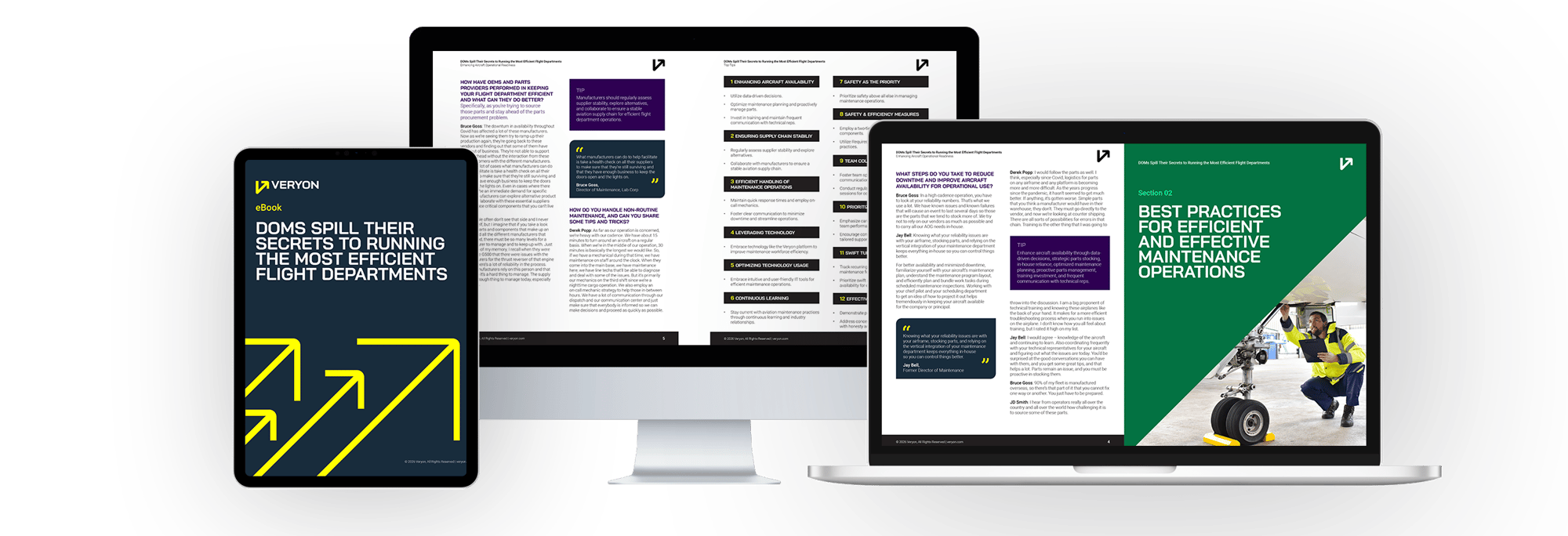
Running an efficient flight department is no small feat. Between parts shortages, tight turnaround windows, staffing pressures, and the constant balancing act between safety and speed, Directors of Maintenance are on the front lines of keeping aircraft mission-ready. So how do the best in the industry make it look effortless?
In this eBook, gain valuable insights, tips, and strategies from top Directors of Maintenance (DOMs) as they share their transformative journey, empowering you to optimize your flight department and enhance its performance.
Meet the experts
Three DOMs in the industry, who collectively bring over 65 years of experience in the world of aviation maintenance, share their insights on the strategies and practices that have enabled them to excel in their roles. They are joined by Veryon Senior Product Manager, JD Smith.

Jay Bell Former Director of Maintenance |

Bruce Goss Director of Maintenance, Lab Corp |

Derek Popp Director of Maintenance, The Boler Company |
Enhancing aircraft operational readiness
What steps do you take to reduce downtime and improve aircraft availability for operational use?
Bruce Goss: In a high cadence operation, you have to look at your reliability numbers. That’s what we use a lot. We have known issues and known failures that will cause an event to last several days so those are the parts that we tend to stock more of. We try not to rely on our vendors as much as possible and to carry all our AOG needs in-house.
Jay Bell: Knowing what your reliability issues are with your airframe, stocking parts, and relying on the vertical integration of your maintenance department keeps everything in-house so you can control things better.
For better availability and minimized downtime, familiarize yourself with your aircraft’s maintenance plan, understand the maintenance program layout, and efficiently plan and bundle work tasks during scheduled maintenance inspections. Working with your chief pilot and your scheduling department to get an idea of how to project it out helps tremendously in keeping your aircraft available for the company or principal.
"Knowing what your reliability issues are with your airframe, stocking parts, and relying on the vertical integration of your maintenance department keeps everything in-house so you can control things better."
Jay Bell, Former Director of Maintenance |
Derek Popp: I would follow the parts as well. I think, especially since Covid, logistics for parts on any airframe and any platform is becoming more and more difficult. As the years progress since the pandemic, it hasn’t seemed to get much better. If anything, it’s gotten worse. Simple parts that you think a manufacturer would have in their warehouse, they don’t. They must go directly to the vendor, and now we’re looking at counter shipping. There are all sorts of possibilities for errors in that chain. Training is the other thing that I was going to throw into the discussion. I am a big proponent of technical training and knowing these airplanes like the back of your hand. It makes for a more efficient troubleshooting process when you run into issues on the airplane. I don’t know how you all feel about training, but I rated it high on my list.
 |
Enhance aircraft availability through data-driven decisions, strategic parts stocking, in-house reliance, optimized maintenance planning, proactive parts management, training investment, and frequent communication with technical reps. |
Jay Bell: I would agree – knowledge of the aircraft and continuing to learn. Also coordinating frequently with your technical representatives for your aircraft and figuring out what the issues are today. You’d be surprised at the good conversations you can have with them, and you get some great tips, and that helps a lot. Parts remain an issue, and you must be proactive in stocking them.
Bruce Goss: 90% of my fleet is manufactured overseas, so there’s that part of it that you cannot fix one way or another. You just have to be prepared.
JD Smith: I hear from operators really all over the country and all over the world how challenging it is to source some of these parts.
How have OEMs and parts providers performed in keeping your flight department efficient and what can they do better?
Bruce Goss: The downturn in availability throughout Covid has affected a lot of these manufacturers. Now as we’re seeing them try to ramp up their production again, they’re going back to these vendors and finding out that some of them have gone out of business. They’re not able to support their overhead without the interaction from these large customers with the different manufacturers. I think in a lot of cases what manufacturers can do to help facilitate is take a health check on all their suppliers to make sure that they’re still surviving and that they have enough business to keep the doors open and the lights on. Even in cases where there might not be an immediate demand for specific parts, manufacturers can explore alternative product lines or collaborate with these essential suppliers who produce critical components that you can’t live without.
Jay Bell: We often don’t see that side and I never have myself, but I imagine that if you take a look at all the parts and components that make up an aircraft and all the different manufacturers that are involved, there must be so many levels for a manufacturer to manage and to keep up with. Just off the top of my memory, I recall when they were making the G500 that there were issues with the manufacturers for the thrust reverser of that engine nacelle. There’s a lot of reliability in the process. Those manufacturers rely on this person and that person, so it’s a hard thing to manage. The supply chain is a tough thing to manage today, especially in aviation.
|
Manufacturers should regularly assess supplier stability, explore alternatives, and collaborate to ensure a stable aviation supply chain for efficient flight department operations. |
"What manufacturers can do to help facilitate is take a health check on all their suppliers to make sure that they’re still surviving and that they have enough business to keep the doors open and the lights on."
Bruce Goss, Director of Maintenance, Lab Corp |
How do you handle non-routine maintenance, and can you share some tips and tricks?
Derek Popp: As far as our operation is concerned, we’re heavy with our cadence. We have about 15 minutes to turn around an aircraft on a regular basis. When we’re in the middle of our operation, 30 minutes is basically the longest we would like. So, if we have a mechanical during that time, we have maintenance on staff around the clock. When they come into the main base, we have maintenance here, we have line techs that’ll be able to diagnose and deal with some of the issues. But it’s primarily our mechanics on the third shift since we’re a nighttime cargo operation. We also employ an on-call mechanic strategy to help those in-between hours. We have a lot of communication through our dispatch and our communication center and just make sure that everybody is informed so we can make decisions and proceed as quickly as possible.
Jay Bell: I think that’s one of the things that we tend to forget as technicians when we’re troubleshooting, especially on the line or in an AOG situation, is the communication with your dispatch and communication with the crew because you have to keep them up to date hourly, maybe even more frequently. It can really affect your operation. If they need to start making plans because they have passengers on board, they’re going to make alternate plans and get some ground transportation. Or if you’re lucky enough to have a multi-aircraft fleet, you may have to send another airplane that involves more crew. Keeping your scheduling department up to date as to what’s going on and when they can expect the next update always helps as well. Communication is a big part of that.
|
Ensure efficient handling of nonroutine maintenance by maintaining quick response times, employing on-call mechanics, fostering clear communication with dispatch, crews, and scheduling departments to minimize downtime and streamline operations. |
Best practices for efficient and effective maintenance operations
How do you measure the success and efficiency of your maintenance operation? What KPIs do you use?
Jay Bell: It really depends on your operation. Availability and maximizing availability and return-to-service time are the biggest performance indicators. Those are the ones that will affect your principals if the aircraft’s unavailable or is out for maintenance on August 25th, and here it is September 3rd, and you’re still not ready. Those are the big indicators and the big drivers of your performance. You can probably get down into little more detailed items, but at the end of the day, the big picture is, can I use the aircraft and is it here? Those are the two biggest ones that I would track.
"Availability and maximizing availability and return-to-service time are the biggest performance indicators... At the end of the day, the big picture is, can I use the aircraft and is it here?"
Jay Bell, Former Director of Maintenance |
Bruce Goss: We proceed a little bit differently. As far as we’re concerned, we fly over 14,000 hours a year, so we have a very structured maintenance schedule. We have a planned amount of time that every maintenance iteration should take. If it blows past the exit window, then we want to know why. We have one spare aircraft to operate 11, so right now we’re in that place where we really need the aircraft to perform at and when we deem necessary. If it’s going to be late, we need to know why. Then we try to mitigate the issues. Maybe we can push a portion of an inspection back or take something else and extend it. Honestly, what we measure is calendar time in and out, as well as the amount of time it takes to get a standard inspection done. If we’ve added anything to it, how many extra days is that taking and why? If it’s a parts issue or a reliability issue, then we’ve got other things. If it’s aging aircraft issues, more than half of our fleet is 15,000 hours per airframe. We’ve got some older frames that have seen some more time, and all of those things play a factor. Primarily a Gantt chart, calendar, and time in and time out is what we use to make sure we’re still efficient and effective.
Jay Bell: A lot of people look at the dispatch reliability of the aircraft and one of the things I would look at is what I term “degraded dispatch”. When you dispatch with a MEL, how many times does that happen? And are you carrying a lot of MELs on your airframes? It’s an indication that it’s time to buy a different year or model.
And then, of course, recurrent defect control was another one. If there was an indication of how your maintenance is performing, recurring defect control helps a lot. Do we need more training on the system? Or is the problem that the system’s poorly engineered and we need to go back to the manufacturer and ask for more engineering support? So those are a couple of things that help.
|
Success in maintenance boils down to swift aircraft turnaround and high availability for operation. Track recurring issues and deferred maintenance instances, reviewing monthly to tailor improvements to your operation’s needs. |
How frequently are you reviewing those KPIs? Daily, weekly, or monthly?
Bruce Goss: For us, we have a monthly schedule and a weekly schedule. At the end of the week, we want to see how the week went and then I produce a report for our corporate entity once a month on how things went, how many hours each aircraft had, what our up-tempo was like, how many aircraft accumulated extra hours rather than the average and based on what issues. So, if we have an aircraft and instead of the normal 150 to 200 hours, we end up with 220 hours, we have an answer as to why we’re weighing heavy on one airframe versus another. Those things are always at the forefront when I’m looking at how we’re operating.
Jay Bell: We weren’t quite as frequent as that. We would do monthly recurring defect controls. We would look at how everything was performing. When you ask these questions to different departments depending upon your operation, you’re going to get different answers and different perspectives. So, no matter what operation you’re in, you must find the solution that fits your operation.
JD Smith: In this industry, there’s always a tightrope between maintaining safety and quality standards and maintaining speed and what you need to do in order to keep the return-to-service times under control.
|
Set a KPI review cadence that matches your operation’s tempo — weekly check-ins to catch issues early, paired with monthly reporting to track trends, recurring defects, and performance against your corporate goals. |
What strategies do you all have to ensure that your maintenance departments are operating efficiently, while also balancing maintaining safety and quality standards?
Bruce Goss: As a Part 91 operator, we don’t have requirements for quality control or a second set of eyes like 121, 135, or 145 operators. In situations related to flight safety, especially considering that most of our aircraft are single-engine turboprops, we take precautions whenever we encounter components like the propeller, engine, flight controls, or flaps that could have safety implications. For such safety-critical items, we employ a two-tier oversight approach. We have a couple of different oversights -- I’ll say the operational type of safety that we use. We have a second technician look at those things. We have a technician who is leading the inspection and will also take another look. Once an aircraft is done with a maintenance iteration, we will have a member of our flight operations management team take it for a test flight. It doesn’t matter what we did to it, we want to go ahead and run it through its paces and make sure that when we release it into service because that’s going to be at night, we want to make sure that the pilot has a good airplane. We have a bunch of different safety requirements that we try to put in place as many layers as possible, to make sure that we don’t have an issue later.
Jay Bell: In the past, during my tenure as a Part 91 operator, we introduced an RII (Required Inspection Items) program. This program involved creating a checklist similar to the 135’s you would see in our RII list, which was affixed to the aircraft’s side at a service center. As we put together a list, we usually would mimic the standard for the airframe. Then we would add things that we felt that we wanted an extra set of eyes on. We would always ensure that before we would go into any inspection of a service center, we would make sure that they were aware that we had an RII list and that we needed RII inspections to be applied. It was more enhanced than what they had for their 145s.
And it’s a hectic world out there sometimes, so having a second set of eyes all the time as a common practice is helpful. Have a good policy and procedures manual to make sure that there’s a standard to everything that you’re doing. We implemented a strong parts inspection program, including suspected unapproved parts to make sure people were aware of how to look for unapproved parts. It was very rare. We didn’t use any vendors that were like that, but I want to make sure that the team was aware that this is a concern in the industry in how we do that.
As a Part 91 operator, you can take a lot of the 135 and 121 policies that are out there and implement them into your operation and it’s free. It doesn’t cost you anything. Just make it a policy and follow it.
|
Maintain safety and efficiency by employing a two-tier oversight system for critical components, utilizing Required Inspection Items (RII), and adopting best practices from higher-tier operators. |
Improving communication between maintenance and flight operation teams
Often, departments can seem at odds due to different priorities. What advice do you Have for operators looking to enhance this communication?
Derek Popp: I believe it starts at the grassroots level with the culture of your flight department and how well the flight department clicks as a team. You really have to respect each other. You have to know the pressures of each department and know that we’re all trying to get the same mission accomplished at the end of the day.
That was going to be my two cents -- the culture of the entire department and keeping those channels of communication open and that conversation flowing freely. If there’s ever a hitch, that hitch needs to be addressed quickly. Otherwise, it can tumble out of control quickly.
"You really have to respect each other. You have to know the pressures of each department and know that we’re all trying to get the same mission accomplished at the end of the day. "
Derek Popp, Director of Maintenance, The Boler Company |
Jay Bell: Culture plays a significant role in this. In my experience, our flight department implemented a sequence of events developed by our chief pilot. Before each flight, about an hour and ten minutes prior, we gathered to discuss the maintenance program, review the airframe’s status, and look ahead to the next 90 days. This practice created a line of communication with each other. We also regularly asked our crew what they needed to complete their missions successfully. At the end of the day, we’re all together trying to move your principal from this destination to the next destination safely and efficiently. And we’re all in that together.
I think it’s always nice when a crew member hears you saying, “What can I do for you to help you make your day easier?” And then you find that, in return, that definitely comes back. But be sure to schedule a brief before and after the trip.
And then, as I was saying before, constant communication with your scheduling department helps. I think it’s something that we all deal with. Everybody’s pulled in multiple directions today, so try to make a dedicated schedule to talk to them, especially during AOG events. Make sure you’re connecting with them right away. One suggestion would be to have an AOG template email in your Outlook or system that you use, so it’s the same template, and the same form going out during AOGs. They know where the plane is located. They know what’s happening. They know when the next update is coming.
And I have a little unorthodox thing so I’ll throw it out there. To create a more cohesive flight department, if you can train together, I think that helps a lot. If you can go to training together, especially if you’re bringing on a new aircraft, then do it. I have found that flying with the crews helped a lot. It helped change my perspective of what they go through.
Bruce Goss: With that kind of interaction, as far as what we do, it’s relatively impossible for our group to go and train together, unfortunately. I mean, that would be great. And we’re a high up-tempo, high cadence kind of operation, so we have two separate pillars that we’re supporting. We have a corporate and a cargo flight department and a maintenance department.
So as a DOM, I’m a go-between both of those sides of the house, as well as our normal interaction. We have an operations dispatch that writes and revisits the schedule daily, so every day our flight schedule is updated. We fly the same routes every day, but weather happens, people are out, aircraft are broken, swaps have to happen, etc. We can go through five to 10 revisions of a flight schedule on a single day. We have our line text to a pass down by email blasted out to the group. Our maintenance team does a pass down and turnover every shift, at the end of the shift, and sends out that email to the entire group.
We also have on-call texts and an on-call dispatch phone number, where anybody can call in and talk to them and figure out what’s going on, where the aircraft’s at, and what the issue is.
And that’s a funnel point of contact. Everybody goes in through dispatch and then back out from dispatch, so we have that single point of information control. Our pilots call into the dispatch and then dispatch will connect them with the mechanics, stay on the line, and have an idea of what is going on so they can report that out in the regular office report, which we also have at the end of every shift.
Anything that is off schedule, off-kilter, late, or different than normal, gets reported. And this is every 8 to 12 hours, depending on which side of the house you’re talking about, flight ops or maintenance.
Maintenance runs on an 8-hour shift versus flight ops running on 12 so there’s overlap. There’s communication at every level. And it’s cadence. It’s never missed. Somebody’s always sending that email out. You can set your watch by it. That constant communication, that constant update, is really what keeps us going, as far as the interaction between all three of our departments.
Jay Bell: When you have too many people trying to send information, it gets very cloudy, and can be very chaotic. Having one single source of information helps a lot.
|
Create a team spirit within your flight department by keeping communication open and honest, holding pre and post-trip discussions, staying in sync with the scheduling team, and considering team training experiences – it’s all about unity for smoother operations and a shared vision. |
JD Smith: I love that you mentioned one of the intangible ways that you can improve communication is just teamwork and potentially training together.
"When you have too many people trying to send information, it gets very cloudy, and can be very chaotic. Having one single source of information helps a lot."
Jay Bell, Former Director of Maintenance |
Can you give some examples of how you’ve seen cross-functional training conducted before?
Jay Bell: I have never had an opportunity to deploy this theory of mine, but one of the things that I would find interesting to develop is what I call Tech Tuesday because I like tacos and I do Taco Tuesday, so I call it Tech Tuesday. I know it’s very hard to get everybody together in a flight department, but if you could get together and you could even do it virtually, pick a system of your aircraft, of your airframe, and talk about it together, crews and maintenance, and talk about what their experiences are with the system, you’d be surprised how much you can learn from the people, from the flight crews who operate, and know what their expectations are of that system.
And then vice versa. The crews can learn a lot from the technicians about how heavily involved it is, and how hard it is to get to. You think it’s so easy, but for me to get to that card, I have to pull all these seats out or, heaven forbid, pull the galley out.
I think when you get them talking to each other and they both have a better understanding, it makes for a more cohesive department.
Sit there and go through that process as a team together. Flight crews, what are your thoughts? Maintenance, and technical crews, what are your thoughts? Have them come together and just discuss that. None of us here are experts on this. We learned it initially. And if you don’t have any issues with that system, you tend to forget about it a little bit. So it’s nice to kind of refresh it and do a little bit of a mini recurrent class with each other in-house if you can.
It’s hard to coordinate it. But it’s just something that gets everybody on the same page and gets everyone talking together. And then, eventually, the topic will veer off to something else and then we’ll all leave the room, hopefully, laughing and smiling.
Bruce Goss: Our safety manager sets up something like this every few months or once every other quarter. We have one day a week where the operation hasn’t quite started yet, where we gather for half a day. And that’s everybody. All pilots, all mechanics, all management, the admin staff, and dispatch. Everybody.
We get together in the hangar. We have IT come and set up a screen. We run through some different subjects, and then we talk and discuss. Usually, it’s a DOM, somewhere on the side of FOD and maintenance fatigue, human factors, and subject matter, just to get the conversation going and get people talking about the different interactions that we have and how we can fix some of the things that we see as broken on a daily interaction.
|
Strengthen collaboration by organizing regular knowledge-sharing sessions for flight and maintenance teams to discuss aircraft systems, and utilize safety meetings to foster inter-departmental cohesion and focus on shared safety concerns. |
JD Smith: I think safety’s a very logical intersection between all the different departments, to bring everyone together like that. I’ve seen emergency response planning, tabletop drills, and things like that, be used in that way.
Motivating your teams
How do you motivate your technicians to achieve optimal productivity, while also ensuring they are satisfied and engaged?
Bruce Goss: Obviously, right now, this one’s kind of tough, right? Everybody’s shorthanded. We’re all dealing with the lack of available staff for just day-to-day operations. It is a new normal now.
Some of the things that I’ve done here, in the past couple of months and over the last two years, is implementing (as long as we don’t have anything heavy going on), a more open time off policy. If you don’t have any time left in the bank, well, then you can take it unpaid. If you really need the time off, just go. If you have a family issue, you don’t need to ask. You just need to go and then send me a text after you get there. Take care of your family. Take care of your personal health and your well-being. And make sure that you’re taken care of, because if you don’t have yourself taken care of, you don’t have anything left to give anybody else.
"Rewriting the script on how the hangar is formed and making different levels of technicians can help."
Bruce Goss, Director of Maintenance, Lab Corp |
And as far as motivating the teams to provide their best effort at work, most small shops have one level of maintenance. And then there’s a Director of Maintenance and that’s it. They don’t see any career progression. They don’t see any difference between what they do today and where it’s going to get them five or 10 years down the road. They’re still just going to be a mechanic.
And this still takes time in big companies, regardless. But rewriting the script on how the hangar is formed and making different levels of technicians can help. Create separation between the levels and show career progression and places for them to excel and move up into.
The larger the operation gets, the more the structure needs to change the support the variation of different operations. Therefore, you create management and supervisor spots that people can then work towards. But you’ve got to show them the path from where they’re currently at and what they’re missing, to get to where they want to be. And then work with them on those gaps.
I have line techs that want to be A&P mechanics who are working on their schooling. I have line techs that want to be pilots and are working dispatch.
I’ve actually promoted a couple here. We have mechanics on the floor that eventually want to be managers or DOMs or any of those variations in between. And it’s just meeting with them on a regular basis, discussing where they want to be, and how to get there, and then helping them along the way -- showing them the steps that they need to take.
That is far more motivating than a $2 pay raise, or a pizza Friday, or any of that. Be physically and mentally involved in their wellbeing.
JD Smith: In a recent poll, the lowest percentage of responses received was incentive and rewards. And that kind of points to exactly what you just said. At a certain point, it’s about someone’s well-being and the fulfillment they get in their work, maybe not adding another zero to the paycheck.
|
Prioritize employee well-being and career development, emphasizing care and a clear career path within the organization, to boost team performance and create a fulfilling work environment that goes beyond financial incentives. |
Which factors make the biggest impact on motivating your team?
Bruce Goss: You can get a dollar-an-hour pay raise anywhere. What we’re trying to provide is something different. It’s a cultural difference, and that’s really what we’re trying to put forward into our group. And it has made a difference. Verifiably, my leadership can see a difference in my mechanics, from before I started to right now. So that, to me, is far more valuable than fighting for a $2 pay raise.
Jay Bell: I think Bruce is exactly right. People want to know that you care because caring for someone doesn’t get taxed. It has more value than you think.
It probably has one of the greatest returns on investment that you can provide.
I was also going to say ice cream, but apparently, it’s not effective...
Bruce Goss: I mean, it’s fun, right? To have ice cream or pizza with everybody. But, really, that’s just to get the conversation started.
What are some tips to prevent burnout? How do you help a struggling team member improve performance?
Bruce Goss: Coaching. We all have at least one person in our past or in our current hangar somewhere who has struggled. Maybe they’re new. Maybe they came from somewhere else, and they weren’t doing all that well there, and nobody cared to support them. You just have to find that one thing that gets through to them and then capitalize on that and use it as that pivot point.
I have an employee right now that I’m working with, and he’s been doing this for four or five years, but he still really hasn’t come into his own. He hasn’t really caught onto it. He’s been in a couple of different places and never had somebody really grab hold of him and say, “Look, you need to just tell me when you don’t understand or when you don’t know or whatever, and we can work with you and move you into the position where you can be at least an expert on one thing,” and then build that confidence and then they become that expert on other things as well because they’re confident enough to go in and try other things.
It’s a confidence builder and a constant interaction. It can be taxing.
And ways to prevent burnout...me, personally? Hobbies. You got to have something where you can turn off your brain. Turn off the cell phone. Put all the electronics away and get away from the day-to-day.
And a lot of people are going to think this is funny. If you look at my LinkedIn profile, it’s all over the place. I’m what’s known as an AFOL. I am an adult fan of LEGO. You can turn off your brain and build something really cool and it gives me not only some mental well-being and some mental peace, but it also me a way to interact with my kids.
Maintenance is labor-intensive and very time-intensive, so I’m always involved in something. It gives me the ability to come back home and pick up something that my kids and I were building together, and it shuts all that outside stuff off, which everybody needs.
You must find that hobby that lets you shut everything else off, whether it’s fishing, building old cars, or painting. For me, it’s dealing with ABS plastic stacked in different shapes.
|
Encourage continuous coaching and tailored support for struggling team members to build confidence and expertise, ultimately enhancing their performance, while also promoting regular engagement in hobbies or activities that allow for a mental break and the ability to disconnect from work to prevent burnout. |
Technology, priorities and advice for DOMs
What technologies or tools have had the most significant impact on your maintenance operations?
Derek Popp: I think tools -- all of the information technology, all of it, you name it, across the line, everything from airframe technology, avionics, to, of course, maintenance tracking. The more intuitive, the more user-friendly your software and your products are going to be, the more efficient you’re going to be at your job.
The more efficient you are at your job, the less time you have to spend doing those updates, printing those cards, putting those work packages together, and the more time you can spend doing those hobbies and turning your cell phone off. Yeah, that is key.
Jay Bell: Yeah, I would say one of the things that really changed everything in aviation (and I know this is going back 10-15 years) is the iPad. I mean, that iPad very quickly made it into the flight stations of aircraft all over the world. Everything that we did was iPad-based. We used what was called Flightdocs, which is now called Veryon Tracking. Everything was on the iPad. We were electronic. So that really changed a lot. All our manuals were there as well.
Anywhere in the world, you had the manual with you, and you had the entire logbook for your aircraft. You can look up anything just from your iPad. It made us mobile, and it really changed a lot.
And I think the ability of an aircraft to send you live reports, while it’s flying, has changed a lot. A lot of information comes out of these airplanes today. And sometimes just sorting through the information is a challenge in and of itself. It makes me long for the old days of the relays and P3s and all those transistors and vacuum tubes, but a lot of information is in those aircraft.
|
Embrace intuitive and user-friendly information technology tools, such as advanced maintenance tracking systems and iPads, to significantly enhance efficiency in maintenance operations. |
What’s your top priority when managing maintenance operations? Safety, efficiency, or cost-effectiveness?
Bruce Goss: Safety.
Jay Bell: Yeah, that’s the first principle. Safety.
And the other two drive off of safety as well. If you’re not safe, the other two are going to go down, too. Safety first.
Bruce Goss: That is the unchanging leg in the triangle. Safety, speed, or cost. Safety is constant. The other two, we’ll figure out.
JD Smith: I heard someone say once, slow is safe and safe is fast, so we got to stick with it.
|
Prioritize safety above all else in managing maintenance operations, as it forms the foundation for efficiency and cost-effectiveness, ensuring a stable and secure operational framework. |
How do you stay up to date with the latest advancements in aviation maintenance practices?
Bruce Goss: Constantly educate yourself. I’m constantly reading. I attend seminars like this. Listen to other people share their wealth of information.
All the manufacturers have seminars where they pass out the latest technical information. Gulfstream, Pilatus. If you’re a helicopter operator, Airbus, Bells, or Leonardo, they all have the same kind of interactive forums. They do them once or twice a year, at a minimum. Get involved with those. If you don’t know how to get involved with them, contact your customer support rep from any one of those manufacturers and they’ll be able to put you in contact with the right people. There’s so much information out there.
Derek Popp: Maintaining good relationships with everyone. It’s everyone from tech reps to vendors, to guys across the field. And it just gives you more and more opportunities to benchmark with those people and keep those open lines of communication.
In this industry, you can put yourself on an island pretty quickly, but it takes good communication and effort to maintain good relationships with your neighbors and your vendors. And it just gives you more opportunities to talk with them. What’s the latest way you do this? What internet system are you putting on your airplane? Hey, did you hear about this and this vendor? Tell me more about it kind of thing...
Bruce Goss: Corporate aviation for sure. That’s a community. Everybody shares so much information there.
If you had one piece of advice to give to other directors of maintenance, what would that be?
Bruce Goss: Be patient.
Jay Bell: I was told once that you are not the super technician behind the desk. You are now a people manager and a resource-getter. Make sure that you have technicians. Make sure they are in the right environment and have the resources that they need to do their job well.
And you’re not perfect. No one is. You’re human, just like everyone else.
Have the escalating pay raises and salary requirements for pilots and flight attendants affected the morale of maintenance technicians?
Bruce Goss: Doesn’t it always? Yeah, I think, as a whole, that’s a pretty easy resounding yes.
And that’s one of those things you have to have an open conversation about with everybody. Set realistic expectations and say, “Look, we’re in this extreme fluctuation right now. What you see out there isn’t necessarily what’s going to happen in here. We’re working on whatever you’re working on.”
Be honest, be upfront, and don’t tell them anything you’re not working on, because as hangars work, a rumor spreads and people talk, and you don’t want to be pushing bad information out there. I side with honesty and communication, 100% on that, all the time.
Jay Bell: Sheryl, President and CEO of Aviation Personnel International, published a fantastic article that she wrote in 2021 about whether we are asking maintenance techs to do too much or not. If you have an opportunity, read that article that she wrote. It’s fantastic and about how we face task saturation, controlling what we do, and how much a maintenance technician is expected.
I think whenever you see someone else get a pay raise, and no matter what industry you’re in, it’s just human nature that the ones who do not get the pay raise will become jealous. And it’s hard to control. Expect it, but it’s hard to control it.
Bruce Goss: The grass is always greener, or not.
Jay Bell: Someone told me once, “Well, no one told you not to be a pilot.” I love what I do. I love working on aircraft and I never had any desire to fly. And for those that do, it is a hard job. You’re away from your family a lot. And there’s a shortage there. So that’s just the market.
Bruce Goss: I think a guy I interviewed recently for a position put it well. Most maintenance people are passionate about what they do. If you did it for the money, then you’re in the wrong environment. There’s no rich aircraft mechanic. There’s no famous aircraft mechanic.
So we don’t do it for that. There’s got to be some level of satisfaction in your job and your day-to-day in what you do and what you’re capable of. Most of us who hang on to this environment for the long haul are in that same boat.
How and where can technology help augment and serve your workforce? And who are the most innovative partners in this space?
Bruce Goss: The guys that we work with at Veryon do a pretty good job of helping us out when it comes to some of our interactions with the system. I mean, it’s people versus technology and you’re always going to have problems with that. I find that the very direct support and the quick response are helpful.
Jay Bell: Yeah, I would agree. Veryon offers a lot for the maintenance side and offers you a lot of options.
One of the things I always liked about them was the support – specifically the IT support from them because we know the maintenance program. When I call, it’s because I can’t figure out how to get the program to produce this report. And they always answer the phone, always walk me through it. And it’s pretty good.
|
Stay current with aviation maintenance practices through continuous learning, attending manufacturer seminars, and fostering relationships within the aviation community for valuable insights and updates. |
And I also like the inventory management side of Veryon.
But, for me, and I’m not saying because you are the sponsor, I really thought that was the best one.
But get some demos and try them out. You may find something else that fits your operation. But there are quite a few out there and the number’s growing.
One of the things I haven’t had a chance to use is MRO Insider, which seems to really be a disruptor in that space. That’s somebody who’s using technology to solve a business thing. It is starting to bleed into the maintenance side a little more now.
What are the differences you’re seeing in the younger versus older applicants in your field?
Bruce Goss: Work ethic. In some cases, a lot of the younger guys haven’t had a lot of technical interaction before they decided to become a mechanic.
20 years ago, schools had wood shop and auto shop. Somebody could try out being hands-on with something before they were thrust into a career. Now that most of that is gone from high schools and junior high schools, you have people figuring out that they may or may not be a hands-on kind of person, after the fact. And you’ve got to deal with that one way or another.
Now, most of the previous generation, I won’t say older guys because I fall into that, we all kind of knew that we liked something a little more hands-on because we were given the opportunity to try it at some point in time (wood shop, metal shop, that kind of stuff beforehand). And then we would think, “I really like this. Maybe I could turn this into a career.”
I think that some of that is part of the current issue. Hands-on experience is not pushed in any public school anymore.
Jay Bell: Yeah. I will say a lot of it is that we were brought up differently. I think Bruce and I are probably from the same generation where we went to school without computers. We were the last generation to do that, and this new generation has information at their fingertips. But I’ve enjoyed working with most of them. I think they bring a new perspective to our industry, especially focusing on work-life balance, which is something that my generation put to the side. And this generation is saying, “Hey, this is important to us.”
And they bring a lot of wonderful things to the aviation industry. I enjoy working with them.