

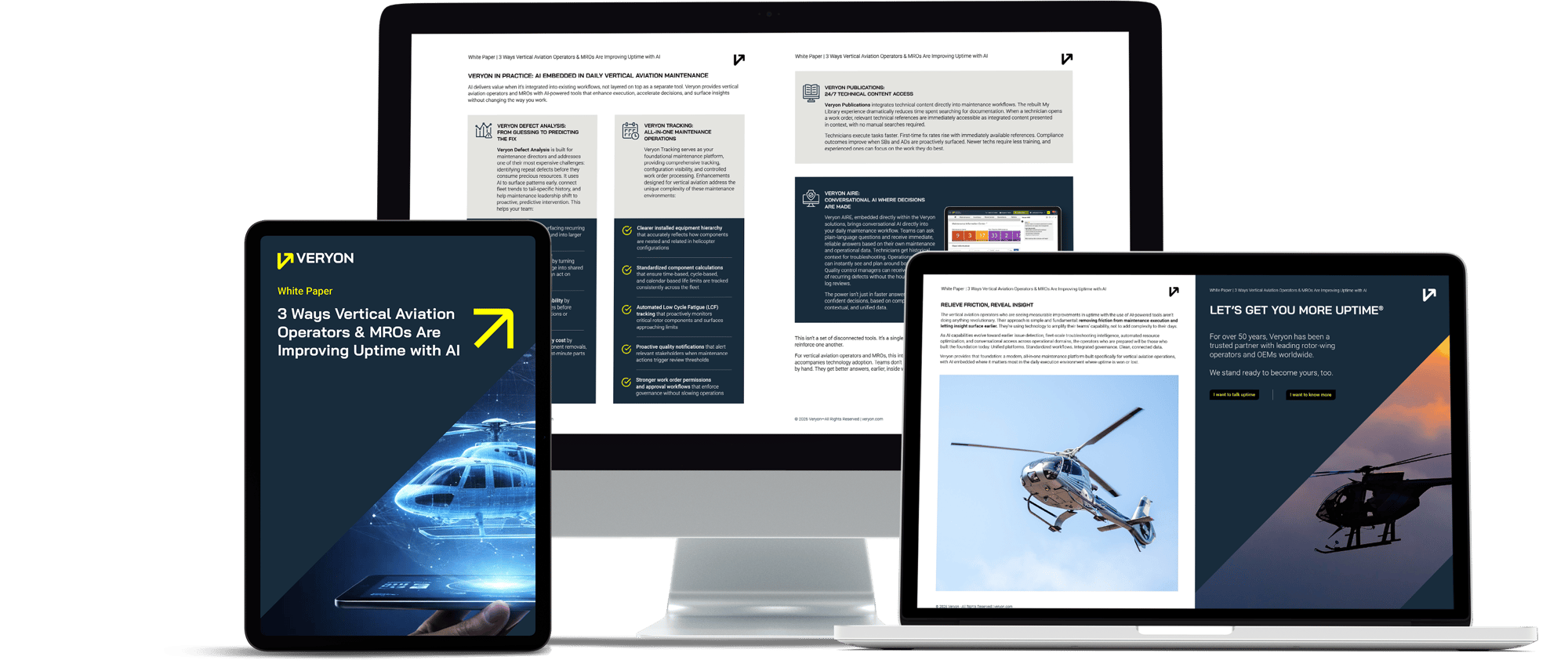
WHITE PAPER
3 Ways Vertical Aviation Operators & MROs Are Improving with AI
Introduction
Downtime accumulates quietly for vertical aviation operators and MROs. It’s hidden by manual processes, fragmented systems, and key insights buried in logbooks. Forward-looking leaders have started fighting back. Not with more new tools to learn and integrate, but with focused, practical applications of AI:
Proactive pattern detection defore downtime occurs |
The problem: Invisible patterns
Repeat defects are among the most expensive, preventable forms of downtime, but the patterns behind them are often revealed only after the costly downtime and parts expenditure.
| The solution:
AI-powered pattern detection continuously analyzes maintenance data across your entire fleet, identifying defects, trends, and warning signals that would otherwise remain hidden. When similar squawks appear across multiple tails, AI can flag that pattern and present it with the aircraft affected, the actions taken, and what data suggests about root causes.
|
Measureable impact
|
AI-driven troubleshooting and decision support |
The problem: Troubleshooting with tribal knowledge
Legacy processes rely on senior technicians' tribal knowledge. When those technicians aren’t available, or the problem is new, work is driven by intuition rather than data, leading to longer turnaround times and lower first-time fix rates.
| The solution:
AI-powered troubleshooting analyzes your fleet's maintenance history and the relationships between installed components to identify likely causes and recommended fixes for any given defect. Instead of starting from scratch, your teams have immediate context to work with, including similar defects on other aircraft, what was tried, and which fixes worked.
|
Measureable impact
|
Intelligent prioritization and faster information access |
The problem: Critical decisions delayed in queues
In traditional queue-based workflows, both critical and routine tasks sit side by side with no clear indication of urgency. Time gets eaten up by manual triage, interruptions, and endless information bottlenecks.
| The solution:
AI helps maintenance teams prioritize work based on operational impact, rather than static queues. It analyzes mission schedules, use patterns, the operator’s part inventory, required technician certifications, and the nature of open defects. By doing so, it surfaces the items that need immediate action and those that can be safely deferred.
|
Measureable impact
|
What tomorrow holds for AI-powered vertical aviation maintenance
While still being refined and developed, these projected AI capabilities are expected to fundamentally reshape the future of maintenance operations, reducing workloads for MROs and operators alike.
Proactive maintenance
AI will flag potential failures before downtime occurs, ensuring early warnings and easier interventions. This intelligence recognizes combinations of factors: unusual vibration trends paired with specific component age, defect patterns appearing in specific environmental conditions, and even maintenance actions that historically precede failures.
Industry-scale troubleshooting
While current troubleshooting support draws on fleet data, AI guidance will become more precise as it leverages industry-wide datasets from aircraft, OEM service data, and regulatory intelligence. Future troubleshooting could well be based on how a specific fault has been presented across the industry, which parts have been affected, and whether recent SBs address its root cause.
Automated task and resource prioritization
AI will automatically sequence tasks and allocate resources based on mission impact, risk, technician availability, and certification requirements. Rather than simply suggesting priorities, it will actively optimize execution plans. This includes delaying lower-priority work to accommodate other critical fixes, identifying opportunities to batch work to minimize total downtime, and balancing technician workload to prevent bottlenecks.
Smart scheduling and workforce optimization
Current tools help plan maintenance. AI will soon dynamically schedule work based on intelligence about technician skills, certifications, shift patterns, parts availability, and operational tempo. It will further identify skill gaps and training priorities, optimize shift coverage, and predict periods of high maintenance demand based on fleet utilization trends.
Conversational data access at scale
Conversational AI will soon enable teams to ask plain-language questions across the entire operational ecosystem: maintenance, operations, supply chain, finance, and regulatory. Maintenance leaders can ask complex cross-domain questions, receive immediate answers, and make fast, confident decisions without manual data extraction or analysis.
These evolving AI capabilities aren’t speculative; they’re being developed and deployed right now. But they share a common prerequisite: unified data, standardized workflows, and embedded governance. Veryon’s one-stop, wide-reaching platform enables all of these.
Veryon in practice: AI embedded in daily vertical aviation maintenance
AI delivers value when it’s integrated into existing workflows, not layered on top as a separate tool. Veryon provides vertical aviation operators and MROs with AI-powered tools that enhance execution, accelerate decisions, and surface insights without changing the way you work.
|
Veryon Defect Analysis: From guessing to predicting the fix
Veryon Defect Analysis is built for maintenance directors and addresses one of their most expensive challenges: identifying repeat defects before they consume precious resources. It uses AI to surface patterns early, connect fleet trends to tail-specific history, and help maintenance leadership shift to proactive, predictive intervention. This helps your team: |
|
|
Veryon Tracking: All-in-one maintenance operations
Veryon Tracking serves as your foundational maintenance platform, providing comprehensive tracking, configuration visibility, and controlled work order processing. Enhancements designed for vertical aviation address the unique complexity of these maintenance environments: |
|
Veryon Publications: 24/7 technical content access
Veryon Publications integrates technical content directly into maintenance workflows. The rebuilt My Library experience dramatically reduces time spent searching for documentation. When a technician opens a work order, relevant technical references are immediately accessible as integrated content presented in context, with no manual searches required.
Technicians execute tasks faster. First-time fix rates rise with immediately available references. Compliance outcomes improve when SBs and ADs are proactively surfaced. Newer techs require less training, and experienced ones can focus on the work they do best.
|
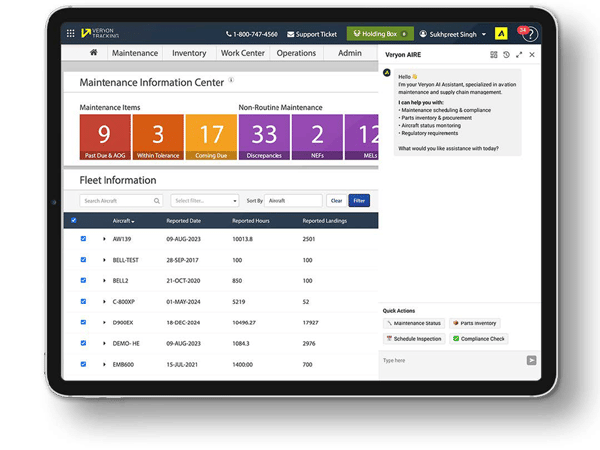
Veryon AIRE: Conversational AI where decisions are made Veryon AIRE, embedded directly within the Veryon solutions, brings conversational AI directly into your daily maintenance workflow. Teams can ask plain-language questions and receive immediate, reliable answers based on their own maintenance and operational data. Technicians get historical context for troubleshooting. Operations leaders can instantly see and plan around bottlenecks. Quality control managers can receive summaries of recurring defects without the hours of manual log reviews. ![]() |
This isn’t a set of disconnected tools. It’s a single maintenance platform where execution, documentation, insight, and AI reinforce one another.
For vertical aviation operators and MROs, this integration matters because it removes the operational friction that often accompanies technology adoption. Teams don’t have to learn new systems, reconcile conflicting data, or move information by hand. They get better answers, earlier, inside workflows they already trust.
Relieve friction, reveal insight
The vertical aviation operators who are seeing measurable improvements in uptime with the use of AI-powered tools aren’t doing anything revolutionary. Their approach is simple and fundamental: removing friction from maintenance execution and letting insight surface earlier. They’re using technology to amplify their teams’ capability, not to add complexity to their days.
As AI capabilities evolve toward earlier issue detection, fleet-scale troubleshooting intelligence, automated resource optimization, and conversational access across operational domains, the operators who are prepared will be those who built the foundation today: unified platforms, standardized workflows, integrated governance, clean, connected data.
Veryon provides that foundation: a modern, all-in-one maintenance platform built specifically for vertical aviation operations, with AI embedded where it matters most in the daily execution environment where uptime is won or lost.
Let’s get you more uptime
For over 50 years, Veryon has been a trusted partner with leading rotor-wing operators and OEMs worldwide. See for yourself how we can become yours too. Fill out the form and our team will set up a tailor-made demonstration.
Not ready for a demo?
Reach out to the team with any questions, or get a quote to understand our pricing.
How can we help?
Just fill out the form and we'll get in touch.
Get a quote
Share a few details about your project so we can provide an estimate.

