



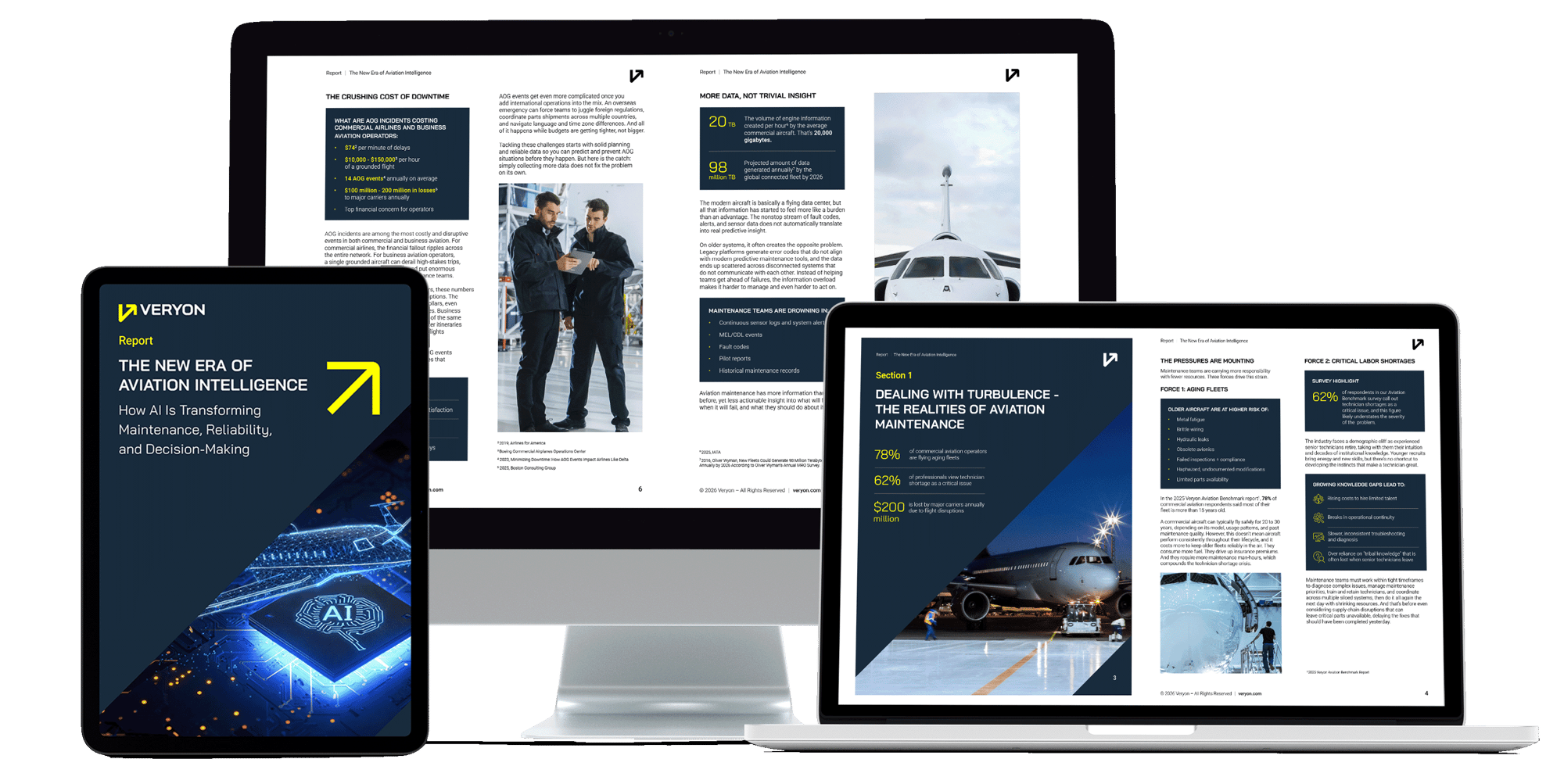
Inside this eBook |
|
 |
The current state of aviation maintenance—and why traditional approaches are falling short |
 |
How AI is transforming aviation maintenance operations |
 |
How Veryon AIRE helps business and commercial operators sharpen efficiency, relieve pressure on maintenance teams, and keep their planes in the air |
Introduction
Why maintenance needs a smarter handbook
Key insights
 |
AOG incidents cost major carriers up to $200 million annually |
 |
70% of aviation organizations believe in the transformative power of AI |
 |
17% have successfully implemented AI |
 |
50% haven’t started their AI journey yet |
Dealing with turbulence
The realities of aviation maintenance
| 78% of professionals view technician shortage as a critical issue |
| 62% of professionals view technician shortage as a critical issue |
| $200m is lost by major carriers annually due to flight disruptions |
The pressures are mounting
Maintenance teams are carrying more responsibility with fewer resources. Three forces drive this strain.
Force 1: Aging fleets
Older aircraft are at higher risk of:
- Metal fatigue
- Brittle wiring
- Hydraulic leaks
- Obsolete avionics
- Failed inspections + compliance
- Haphazard, undocumented modifications
- Limited parts availability
In the 2025 Veryon Aviation Benchmark report1, 78% of commercial aviation respondents said most of their fleet is more than 15 years old.
A commercial aircraft can typically fly safely for 20 to 30 years, depending on its model, usage patterns, and past maintenance quality. However, this doesn’t mean aircraft perform consistently throughout their lifecycle, and it costs more to keep older fleets reliably in the air. They consume more fuel. They drive up insurance premiums. And they require more maintenance man-hours, which compounds the technician shortage crisis.
12025 Veryon Aviation Benchmark Report
Force 2: Critical labor shortages
Survey highlight 62% of respondents in our Aviation Benchmark survey call out technician shortages as a critical issue, and this figure likely understates the severity of the problem.
The industry faces a demographic cliff as experienced senior technicians retire, taking with them their intuition and decades of institutional knowledge. Younger recruits bring energy and new skills, but there’s no shortcut to developing the instincts that make a technician great.
Growing knowledge gaps lead to:
 |
Rising costs to hire limited talent |
 |
Breaks in operational continuity |
 |
Slower, inconsistent troubleshooting and diagnosis |
 |
Over reliance on “tribal knowledge” that is often lost when senior technicians leave |
Maintenance teams must work within tight timeframes to diagnose complex issues, manage maintenance priorities, train and retain technicians, and coordinate across multiple siloed systems, then do it all again the next day with shrinking resources. And that’s before even considering supply chain disruptions that can leave critical parts unavailable, delaying the fixes that should have been completed yesterday.
Force 3: Part scarcity
One of the toughest problems maintenance teams face as fleets age is the increasingly desperate search for replacement parts. When an aircraft model has been out of production for a decade or more, the seemingly simple task of replacing a failed component can turn into a complex treasure hunt spanning continents, involving multiple suppliers, and grounding an aircraft for weeks or even months.
While there are other options outside of purchasing directly from OEMs, they each come with their own challenges:
Sourcing components from retired aircraft takes serious legwork. Technicians have to track them down, pull them off, inspect them, and then hope that hidden wear or damage does not disqualify them from use. There is never a guarantee they will meet your fleet’s airworthiness requirements.
Parts from third-party manufacturers rarely go through the same level of testing as OEM components. Even small differences in materials or tolerances can cause issues that only surface once the aircraft is flying. That leaves maintenance teams with extra troubleshooting, closer monitoring, and more documentation to manage.
Custom fabrication eats up time and expertise, both of which are already stretched thin. Failed components have to be reverse-engineered, validated with regulators, and then manufactured, often at a high cost.
Maintaining rare part inventories can tie up millions of dollars in capital. Many of these components need climate-controlled storage and routine inspections, and some will degrade long before they are ever used. Operators end up holding shelves of parts with little to no resale value, even though they are vital to keep aging aircraft flying. On top of that, teams must guess at failure rates with limited historical data, weigh the risk of AOG events against inventory budgets, and hope that regulatory shifts do not instantly devalue their entire stock.
The crushing cost of downtime
What are AOG incidents costing commercial airlines and business aviation operators:
-
$742 per minute of delays
-
$10,000 - $150,0003 per hour of a grounded flight
-
14 AOG events4 annually on average
-
$100 million - 200 million in losses5 to major carriers annually
-
Top financial concern for operators
AOG incidents are among the most costly and disruptive events in both commercial and business aviation. For commercial airlines, the financial fallout ripples across the entire network. For business aviation operators, a single grounded aircraft can derail high-stakes trips, damage customer relationships, and put enormous pressure on already stretched maintenance teams.
For some large-fleet commercial operators, these numbers translate into significant operational disruptions. The resulting losses can run into millions of dollars, even before compliance and regulatory penalties. Business aviation teams deal with a different flavor of the same pain: executive travelers left waiting, charter itineraries reshuffled, crews displaced, and revenue flights slipping away.
Beyond the immediate financial costs, AOG events trigger a cascade of operational challenges that amplify their impact:
- Disrupted schedules
- Passenger and customer dissatisfaction
- Crew scheduling conflicts
- Network-wide or fleet-wide delays
AOG events get even more complicated once you add international operations into the mix. An overseas emergency can force teams to juggle foreign regulations, coordinate parts shipments across multiple countries, and navigate language and time zone differences. And all of it happens while budgets are getting tighter, not bigger.
Tackling these challenges starts with solid planning and reliable data so you can predict and prevent AOG situations before they happen. But here is the catch: simply collecting more data does not fix the problem on its own.
22019, Airlines for America
3Boeing Commercial Airplanes Operations Center
42023, Minimizing Downtime: How AOG Events Impact Airlines Like Delta
52025, Bonston Consulting
More data, not trivial insight
| 20 TB The volume of engine information created per hour6 by the average commercial aircraft |
| 98m TB Projected amount of data generated annually7 by the global connected fleet by 2026 |
The modern aircraft is basically a flying data center, but all that information has started to feel more like a burden than an advantage. The nonstop stream of fault codes, alerts, and sensor data does not automatically translate into real predictive insight.
On older systems, it often creates the opposite problem. Legacy platforms generate error codes that do not align with modern predictive maintenance tools, and the data ends up scattered across disconnected systems that do not communicate with each other. Instead of helping teams get ahead of failures, the information overload makes it harder to manage and even harder to act on.
Maintenance teams are drowning in:
- Continuous sensor logs and system alerts
- MEL/CDL events
- Fault codes
- Pilot reports
- Historical maintenance records
Aviation maintenance has more information than ever before, yet less actionable insight into what will fail, when it will fail, and what they should do about it.
62025, IATA
72016, Oliver Wyman, New Fleets Could Generate 98 Million Terabytes of Data Annually by 2026 According to Oliver Wyman’s MRO Survey.
Business vs. commercial aviation:
RISING TO CHALLENGES
Business and commercial aviation operators both struggle to address these challenges and their consequences, but they also face significantly different concerns.
BUSINESS AVIATION: RESOURCE RARITY
Business aviation maintenance teams operate in a world of constant resource constraints. According to the 2025 Veryon Aviation Benchmark Report1:
- 77% want tools that eliminate redundant workflows and accelerate decision-making
- 68% express frustration with outdated systems and manual processes
- 68% report significant hiring and retention challenges
- 54% identify cost predictability as a primary concern
- 44% see technician shortages as the biggest threat to maintenance operations
These smaller operations often lack the resources to invest in comprehensive maintenance management systems, leaving them dependent on spreadsheets, paper records, and the institutional knowledge of a handful of key personnel. When a critical technician leaves, years of expertise walk out the door with no systematic way to capture or transfer that knowledge.
12025 Veryon Aviation Benchmark Report
COMMERCIAL AVIATION SCALE AND COMPLEXITY
Commercial operators face a different but equally daunting set of challenges. Our report reveals:
- 89% focus on improving maintenance tracking to reduce turnaround time
- 82% struggle with synchronizing data across their fleets
- 76% report that unplanned maintenance severely disrupts operations
- 59% still rely on a patchwork of systems rather than a standardized platform
Despite having invested in predictive analytics, commercial operators still face significant challenges. They are less concerned about technician shortages, but it still represents a critical vulnerability. The bigger the organization, the more that is at stake. Any solution to the problem must withstand the massive scale of implementation required.
THE BREAKING POINT WHY INTELLIGENCE IS THE ONLY PATH FORWARD
Aviation AI-powered solutions can-and must:
- Turn massive data streams into usable insights
- Predict potential failures before they happen
- Capture institutional knowledge while it still exists
- Help newer technicians work with greater skill and confidence
- Optimize resources across complex maintenance operations
- Support both the tight constraints of business aviation and the large-scale demands of commercial fleets
The aviation maintenance industry has hit a real breaking point. Traditional fixes such as adding more technicians, adding more steps, or collecting more data have reached their limits, and incremental solutions are insufficient. The only scalable path forward is artificial intelligence. The technology is here, and the data is already in hand. What the industry needs now is the vision and commitment to shift maintenance from a reactive obligation to a proactive, intelligent advantage.
Your new maintenance co-pilot
Veryon AIRE: strengthening airworthiness, reliability, and intelligence
Change is in the AIRE
Operators aren’t struggling with ambition. They’re struggling with information. 72% of maintenance teams say efficiency is their top priority, yet the data they need is buried in systems that don’t talk to each other. Veryon AIRE adds an aviation-trained intelligence layer directly inside the Veryon products you already use. No extra system. No new platform. Just the tools your team relies on every day, now powered with real-time insight, prediction, and context.
What is Veryon AIRE?
Veryon AIRE is an AI maintenance co-pilot built specifically for aviation and embedded across the Veryon product suite. It’s trained on real operational history, understands aviation terminology and compliance requirements, and uses that knowledge to deliver guidance that feels practical and trustworthy.
Built for trust: Safety and compliance first
Veryon AIRE is designed to strengthen safety standards with features that include:
- Complete traceability for every recommendation
- Audit trails for regulatory compliance
- Role-based access for multiple authorization levels
- De-identified model training that protects proprietary information while improving system intelligence
Immediate, practical impact
There’s no new system to learn. Veryon AIRE simply makes existing workflows smarter. Operators see real-time fleet updates, automated shelf-life and inventory monitoring, planning aligned with downtime windows, and always-on compliance awareness.
When information becomes easier to access and understand, teams move faster. When the software can predict what’s coming, downtime shrinks. And when critical moments hit, conversational AI isn’t a nice-to-have. It’s the difference between guessing and knowing.
Operators Using AI-Powered Veryon Products Report Transformative Results:
- 95% predictive accuracy in parts forecasting
- 75% faster troubleshooting times
- 31% fewer repeat defects
- 23% lower downtime costs
- Up to 12% higher aircraft availability
What Veryon AIRE does
Veryon AIRE combines the industry’s largest de-identified dataset with proven data science and decades of real-world aviation expertise. Inside the Veryon product suite, this intelligence shows up as conversational assistance, expert guidance, and smart automation that helps shift work from reactive to proactive.
Here’s what it looks like in practice:
 |
Smarter, faster fixes. It recommends the most likely fixes to boost first-time fix rates and enables technicians to ask publication-specific questions and jump directly to troubleshooting steps. |
 |
Intelligent fleet management. It automates routine work, reduces maintenance expenses, and optimizes critical maintenance tasks and inventory management. |
 |
Enhanced reliability. It surfaces chronic patterns, rogue components, and short-life parts, and trends degradation early, before they escalate into unexpected AOGs. |
Breaks down data silos
Before: Data scattered across PDFs, spreadsheets, and multiple systems.
After: Veryon AIRE ties everything together behind the scenes. Ask a question and the system responds with a complete, connected answer.
Accelerates fixes with prescriptive maintenance
Before: Trends remained hidden until they led to a failure.
After: Veryon AIRE continuously analyzes historical and real-time data to surface early signs of recurring defects so teams can act before something breaks.
Speeds up action with natural language processing
Before: Mechanics waste valuable hours on fixing and re-fixing the same defects.
After: Veryon AIRE lets teams identify and fix defect patterns early. It extracts insights from your logbook data and maintenance reports to flag repetitive defects after just two occurrences.
Why it matters: Business aviation
In business aviation, an aircraft stuck on the ground isn’t just inconvenient. It breaks a promise. When a business jet can’t get an executive to a make-or-break meeting or another misses a roadshow because a part wasn’t sourced in time, everyone feels it.
Veryon AIRE helps teams stay ahead of those moments by powering the Veryon products with the clarity and prediction needed to avoid surprises.
For Technical PublicationsVeryon Publications turns into a fast, context-aware assistant with Veryon AIRE powering the search. Before: Techs dug through manuals and cross-referenced everything by hand. After: Veryon AIRE answers natural questions and points directly to the right step, spec, or bulletin. It keeps work moving, even when the DOM is remote. |
For Maintenance TrackingVeryon Tracking becomes a proactive maintenance coordinator with Veryon AIRE as its engine. Before: Teams manually juggled due items, inspections, and parts. After: Veryon AIRE automatically builds due lists from hours and cycles, checks inventory across bases, and even looks ahead to combine tasks into a single downtime window. |
Why it matters: Commercial aviation
Commercial operations run on tight windows. Every minute counts, and IATA estimates each delay minute costs about $74. Maintenance issues aren’t just frustrating. They’re expensive.
The data needed to prevent disruptions is already there, but it’s scattered. Veryon AIRE integrates into the Veryon suite, so airlines can spot what’s about to cause a delay and take action before the clock starts ticking.
For Defect Pattern Detection
Before: Chronic issues slipped through as separate events. After: Veryon AIRE clusters them, highlights failed corrective actions, and shows operators what’s recurring and why. |
For Maintenance TroubleshootingVeryon Guided Troubleshooting becomes a hangs-on diagnostic partner with Veryon AIRE at its core. Before: Techs started with broad isolation and too little time. After: Veryon AIRE ranks root-cause probabilities, links directly to the correct procedure, and helps tech jump straight to a targeted fix. |