



6 min read
A day in the life of an SVP of Maintenance & Engineering
The day usually starts the same way. The schedule looks clean. Aircraft are assigned. Crews are covered. On paper, the operation is solid.
Experience says that doesn’t mean much.
What really matters is what showed up overnight. The logbook entries that didn't look urgent. The write-ups that sound familiar but aren't identical. The kind of issues that don't trigger alarms until suddenly they're everywhere.
For an SVP of Maintenance & Engineering, the job lives in a constant gray area. Hundreds of aircraft. Thousands of maintenance events every day. Pressure from operations to keep airplanes moving and pressure from finance to keep spending tight. Every decision carries weight, and most of them are made before the full picture is clear.
The real risk isn't the defect everyone already knows about. It's the one that's appeared twice in slightly different language and hasn't been connected yet. That's how manageable issues quietly turn into delays, cancellations, and long afternoons on conference calls.
That's why the first few hours of the day matter more than anyone outside maintenance realizes.
What keeps them up at night isn't a single aircraft or a single event. It's whether the fleet stays on schedule or gets derailed by unscheduled maintenance.
- Repeat defects that quietly cascade into fleet-wide delays and cancellations before engineering can validate and issue fixes
- Reliability engineering time lost to validation and data cleanup instead of root cause analysis and corrective action
- Limited ability to prove that reliability investments are preventing real operational losses, not just adding cost
- High parts waste and unscheduled removals driven by trial-and-error troubleshooting across the fleet
- Operational performance targets at risk because trends surface too late to prevent disruption
This is the backdrop for every decision that follows. And it's why the day doesn't really start at the first meeting. It starts the moment the overnight data comes in.
7 a.m. | Morning Reliability Brief
By 7 a.m., the SVP of Maintenance & Engineering is already in the day's first decision window. Overnight PIREPs and MAREPs are coming in from across the network. Aircraft that landed late are mixing with early-morning departures. Fleet status screens sit next to yesterday's delay report.
This is where small problems either get caught early or quietly blend into the background.
A few write-ups stand out. Same system. Different aircraft. Different stations. Different wording. None of them looks critical on its own. But taken together, they raise a familiar question: coincidence, or the beginning of something bigger?
This is where traditional reliability processes start to fall apart.
Thousands of PIREPs and MAREPs a day are more than any team can manually connect. Logbook narratives vary by technician. ATA coding isn't consistent. Analysis and validation take time, and time is the one thing the operation doesn't have.
Engineers may spend days or days, that bleed into weeks, confirming whether these are real repeats. By the time a pattern is validated, it’s often already driven by delays, cancellations, or crew swaps somewhere in the system.
The morning brief becomes reactive. Focused on what already happened, not what’s about to.
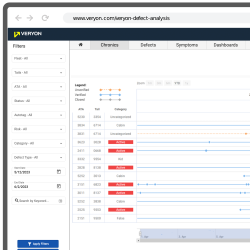
Veryon Defect Analysis removes the delay between data and insight.
National language processing (NLP) automatically analyzes thousands of PIREPs and MAREPs, clustering related defects even when the wording doesn't match. A hydraulic fault described in three ways is treated as a single issue, not three unrelated events.
Defects are flagged by the second occurrence, not the fourth or fifth. Fleet dashboards surface active, recurring issues in near-real time, ranked by severity and operational impact.
Operators using Veryon Defect Analysis reduce delays and cancellations simply by identifying fleet-wide patterns weeks earlier.
The morning brief stops being about archaeology and starts being about priorities.
10 a.m. | Engineering Review and Prioritization
Late morning brings the reliability engineering review. Chronic defect candidates are on the table. Historically, this is the result of hours and days of spreadsheet work, screenshots, and manual cross-checking.
Now leadership has to decide where limited engineering resources should go.
Reliability engineers are among the most valuable people in the organization, yet they spend too much time validating data rather than fixing problems.
Manual validation can't keep pace with the volume of events. False positives waste time, and missed patterns keep popping up across the fleet, wreaking havoc on the schedule.
Without clear, trusted prioritization, decisions drift toward the loudest operational pain rather than the highest long-term impact.
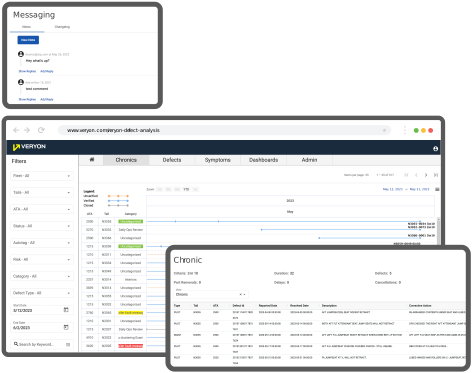 Defect Analysis automates validation before the meeting even starts
True repeat defects are already identified and clustered. Noise is filtered out. Each issue is ranked based on actual fleet impact, such as delays, cancellations, AOG exposure, and parts waste.
By eliminating manual validation, engineering teams get meaningful time back to focus on root-cause analysis and implement corrective actions sooner.
The discussion shifts from "is this real?" to "how do we fix it and prevent it from spreading?"
1 p.m. | Operational Disruption
Early afternoon, operations call. Multiple aircraft at different stations are reporting the same hydraulic issue. Delays are starting to stack up. Crews are waiting. The clock is running.
The questions come fast. Is this isolated? Have we seen it before? Did the last fix actually hold?
In the moment, history matters more than theory.
Without fast fleet-wide visibility, teams scramble. Logbooks are searched. People are called. Parts get ordered "just in case." Maintenance Control and line maintenance teams are forced to make educated assumptions under pressure.
That's how one defect turns into several delays.
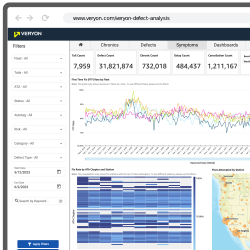 With Defect Analysis, the full picture is already there.
Every historical occurrence across the fleet is visible in one view. Corrective actions are shown alongside time-to-recurrence data, making it clear which fixes actually worked and which ones failed quickly.
Patterns reveal whether the issue is tied to specific aircraft, configurations, or operating conditions.
Operators see a 15-30% improvement in first-time-fix rates by giving maintenance teams instant access to fleet-wide corrective action history during disruptions.
The event still happens. It just ends faster and with fewer wrong turns.
3 p.m. | Leadership Review Prep
Later in the afternoon, the focus shifts upward. Monthly operations review. CFO questions. Board expectations.
The SVP knows what's coming: justify reliability spend.
Preventing delays doesn't show up cleanly on financial statements. When things go right, it looks like nothing happens.
Without clear metrics, maintenance leaders end up defending proactive work with stories instead of numbers. That's a tough position when budgets are under scrutiny.
5 p.m. | Audit Support and CASS Evidence Pack
Before the day wraps, a regulatory request comes in from the FAA oversight team ahead of a schedule review for documentation on a rising repeat defect trend, including CASS analysis, corrective actions taken, and evidence that the fix is working.
Traditionally, this triggers a scramble. Data is pulled from multiple systems. Spreadsheets reconciled. Gaps hunted down.
It takes days, and incomplete documentation creates real audit risk.
What changes by the end of the day
The pressure doesn't disappear. Aircraft still generate write-ups. Schedules remain tight.
What changes is the clarity behind each decision.
Repeat defect trends surface earlier. Engineering time shifts from manual validation to root cause action. Reliability discussions are grounded in structured defect history rather than anecdotal escalation. Leadership conversations are backed by data that holds up with operations, finance, and regulators.
Catching a defect on the second occurrence instead of the fifth often makes the difference between targeted corrective action and network-level disruption. At airline scale, that difference shows up in dispatch reliability, passenger impact, and millions in operational cost.
Veryon Defect Analysis doesn't eliminate risk. It brings structure to it, making repeat defects visible, explainable, and proactively manageable
Get started with Veryon Defect Analysis
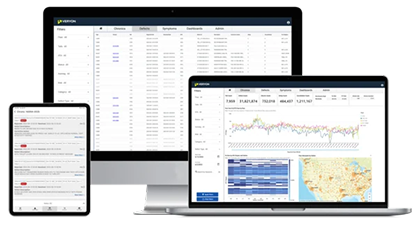 If this day feels familiar, it probably is.
Veryon Defect Analysis is built for airline maintenance leaders who want fewer surprises, faster data-driven decisions, and confidence that repeat defects won't snowball undetected into bigger problems and disruptions.
If you’re ready to see how it works in your operation, book a demo and take a closer look at how Veryon Defect Analysis turns logbook noise into actionable insight.

Want more resources?
Explore Veryon's full library of expert content and aviation insights — from maintenance tracking to diagnostics, predictive reliability, and beyond.



Stay connected
Join thousands of aviation professionals who turn to Veryon for insights on predictive maintenance, industry innovation, and emerging tech trends.
Follow Veryon on LinkedIn and be part of the conversation driving aviation's digital transformation.